In writing this article, I gathered the most important information to help beginner photographers use an external flash in manual mode. This mode gives full control over light, unlike natural light, which we have to adapt to. Most flash units offer automatic flash metering, useful when a photograph needs to be taken quickly, but manual mode makes “creative exposure” possible.
Many photographers using a built-in flash notice strongly contrasting, flat lighting on the main subject and an underexposed background with distinct shadows.
When photographing in ambient light, we work with the exposure triangle: aperture, shutter speed and ISO. I usually use ISO 100–200, so aperture and shutter speed remain the key factors.
Many combinations can give a correct exposure, but only one will be creative. For a portrait, we want shallow depth of field and a blurred background, so we choose a wide aperture such as f/2.8. This determines the shutter speed and creates a creative exposure. A large depth of field would be technically correct but less visually attractive.
How do we combine this with flash? A flash lasts a fraction of a second, so we cannot meter the light in the same way as ambient light.
When working with flash, aperture is crucial. At shutter speeds no faster than the flash sync speed, shutter speed primarily affects ambient light. By adjusting it, we can brighten or darken the background, or almost eliminate it altogether (e.g. by shortening the exposure by 3–4 EV compared with the meter reading).
Aperture depends on the distance between the flash and the subject. The flash can be moved closer or farther away, so “creative exposure” still determines the choice of aperture. First, we choose the aperture (small opening = large depth of field, large opening = shallow depth of field), then check how far away the flash needs to be at a given power.
The flash can be mounted on the camera’s hot shoe or on a stand, triggered by radio or cable.
Light intensity decreases in inverse proportion to the square of the distance. Doubling the distance means the flash is four times weaker (only 25% of the light reaches the subject). This is why flash has a limited range. To illuminate more distant subjects, you need more flash units or a longer exposure to make use of ambient light.
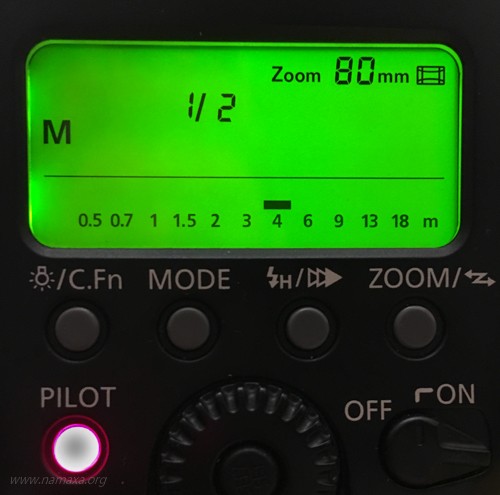
To control the flash, set manual mode (“M”). Power adjustment is useful when working with a diffuser, bouncing light off the ceiling or using flash as fill light on a sunny day. 1/1 is full power, 1/2 is half power, and so on.
Flash zoom controls the width and range of the flash beam. We usually match the zoom to the lens focal length, but using a higher zoom setting lets us illuminate a selected part of the frame more strongly by narrowing the beam.
Standard flash sync speed is around 1/180 s (depending on the camera). At shutter speeds faster than the sync speed, without HSS, black bands may appear — part of the sensor is not illuminated by the flash.
For example: shooting into the sun. The correct exposure for the sky requires a fast shutter speed, so the foreground subject becomes a silhouette. The solution is HSS (high-speed sync). The flash then works like a strobe, emitting a series of pulses as the shutter curtain moves. Remember that HSS reduces effective flash power; the extent of the reduction depends on the flash model and the selected shutter speed.