Shooting with a very wide aperture is mainly associated with a strongly blurred background and shallow depth of field. But does F/1.4 really always mean that only a small part of the subject will be sharp?
I decided to test this in practice. For the photographs, I used a Canon EOS R6 Mark II and Canon RF 85 mm F/1.4 L VCM, with Lola as my model.
This is not a laboratory test. I was primarily interested in what you see during normal photography: how depth of field, subject separation from the background and the character of the photograph change with different apertures and different distances from the subject.
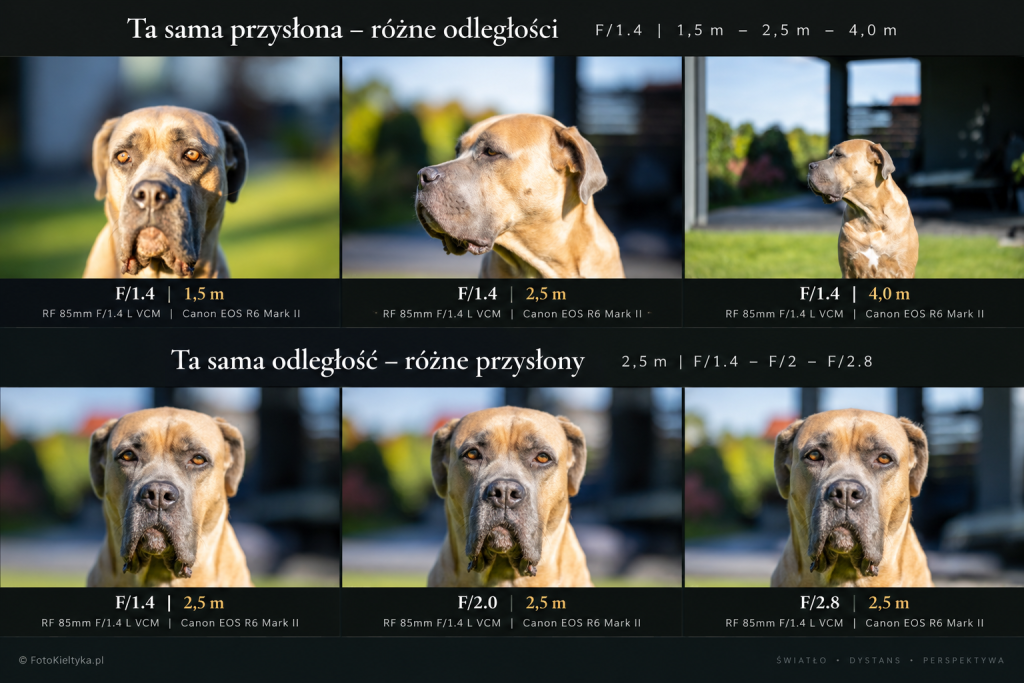
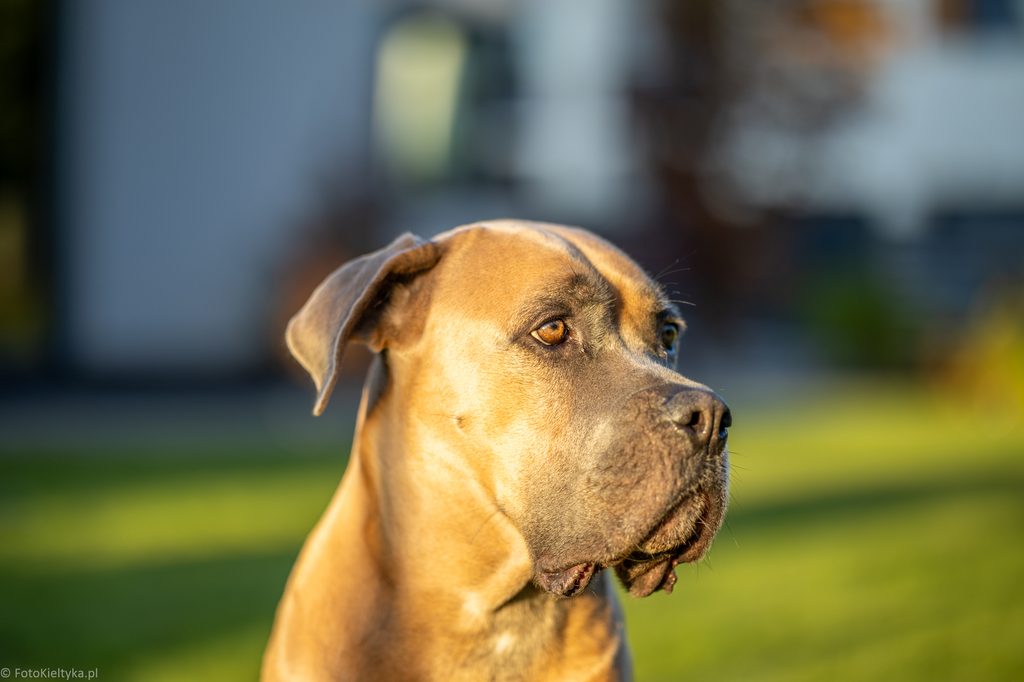
To begin, I shoot from a short distance — around 1.5 m — with the aperture fully open at F/1.4.
With this combination, depth of field is very shallow. The eyes may be sharp while the nose projecting towards the camera is already outside the sharpest zone. At the same time, the background is heavily blurred and virtually stops competing with the subject.
This clearly shows how demanding shooting at F/1.4 from a short distance can be. Precise focusing becomes extremely important.

I do not change the aperture — I am still shooting at F/1.4 — but increase the distance to around 2.5 m.
The effect is very interesting. The background remains strongly blurred, and Lola is clearly separated from it. At the same time, more of her head is now within the range of acceptable sharpness.
This is where it becomes clear that depth of field is not determined solely by the number next to the letter “F”. The distance between the camera and the subject also matters a great deal.
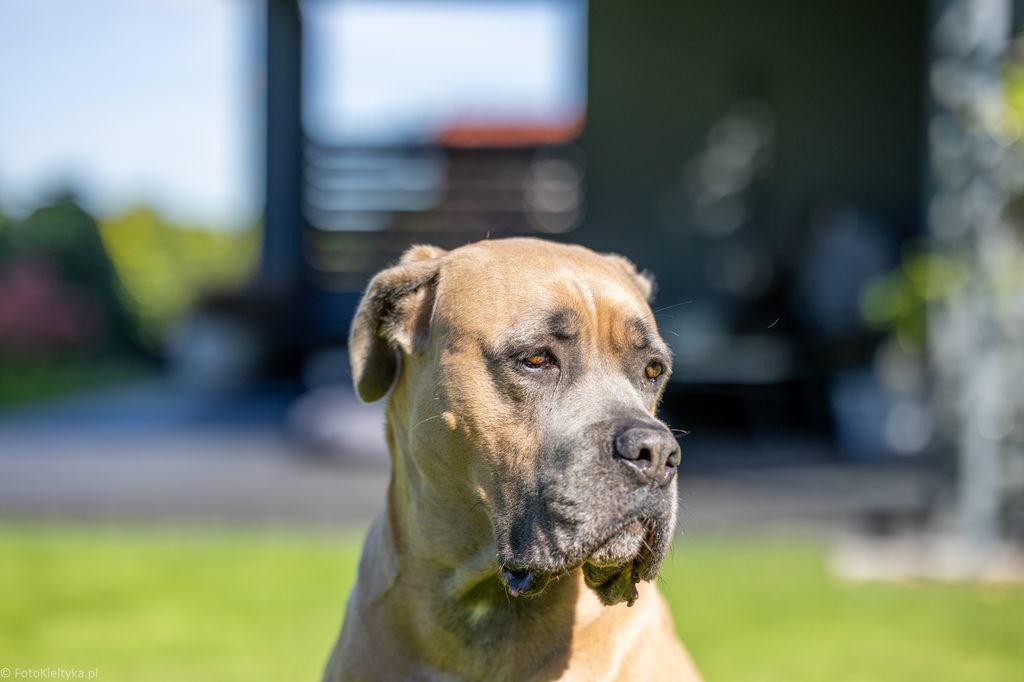
I take the next photograph still at F/1.4, but this time from a distance of around 4 m.
The difference compared with the photograph taken from 1.5 m is very clear. Despite the identical aperture, depth of field is greater. At the same time, thanks to the 85 mm focal length, the background remains soft and clearly separated from the subject.
This is one of the most important conclusions from this comparison for me: F/1.4 does not always have to mean an extremely shallow depth of field. As the distance from the subject increases, so does the range of space perceived as sharp.

The second part of the comparison shows something different. This time, the distance is around 2.5 m, and I change the aperture.
I compare F/1.4, F/2 and F/2.8.
At F/1.4, I get the shallowest depth of field and the strongest separation between the subject and the background. The background is very soft, and attention automatically focuses on the model’s eyes and head. The example photograph is shown above.
After stopping the lens down to F/2, depth of field begins to increase noticeably. More of the head falls within the sharp zone, but the background remains strongly blurred.
In practice, F/2 can be a very good compromise between the distinctive look of a fast lens and a greater margin for error when focusing.
At F/2.8, depth of field increases further. However, this does not mean the characteristic effect of a portrait taken with an 85 mm lens suddenly disappears.
The background remains clearly blurred, and the subject is well separated from it. What I gain is greater flexibility when I want to keep more of the head sharp.

Comparing these photographs reveals something easy to forget when discussing fast lenses. Aperture is not the only factor affecting the appearance of depth of field.
The distance between the camera and the subject, the focal length, and the distance between the subject and the background also matter enormously.
That is why two photographs taken at F/1.4 can look completely different. At 1.5 m, the sharp zone is very small. At 4 m, the same aperture gives a much greater range of sharpness while still allowing strong separation between the subject and the background.
I do not treat F/1.4 as a setting that must be used simply because the lens offers it.
For a close portrait, F/1.4 gives a very distinctive effect but requires highly precise focusing. At a greater distance, using F/1.4 becomes much easier.
F/2 gives a slightly greater margin for error while retaining very strong background separation. At F/2.8, depth of field increases further, but at 85 mm we can still achieve very pleasing background blur.
The choice of aperture therefore depends primarily on the effect I want to achieve and the distance from which I am shooting.
This simple test confirmed my belief that, when shooting with a fast lens, it is worth looking beyond the aperture value alone.
F/1.4 offers enormous possibilities, but the distance from the subject can change the character of a photograph just as much as changing the aperture itself.
At 1.5 m, F/1.4 means a very shallow depth of field and requires precise focus on the eye. At 2.5 m, things become much more comfortable. From around 4 m, you can still use the characteristic blur of F/1.4 while having a considerably greater range of sharpness.
F/2 and F/2.8 are therefore not “worse” settings to me. They are simply additional tools for deciding how much of the subject should be in focus and how strongly I want to separate it from the background.
And it is precisely the ability to make a deliberate choice between F/1.4, F/2 and F/2.8 that I consider one of the greatest advantages of shooting with a fast 85 mm lens.