How to Photograph the Sea: Shutter Speed, Waves and Water Colours

The sea is one of the most fascinating subjects in landscape photography. At first glance, we are always photographing a similar scene — water, a shoreline and the horizon. In reality, every photograph can look completely different.

The character of an image is shaped by light, weather, wave movement, water colour, composition and, above all, shutter speed.

Two very different coastlines provide a good example: the area around Brela on the Adriatic and the Polish beaches of the Baltic Sea. The former...
The sea is one of the most fascinating subjects in landscape photography. At first glance, we are always photographing a similar scene — water, a shoreline and the horizon. In reality, every photograph can look completely different.

The character of an image is shaped by light, weather, wave movement, water colour, composition and, above all, shutter speed.

Two very different coastlines provide a good example: the area around Brela on the Adriatic and the Polish beaches of the Baltic Sea. The former is associated with clear turquoise water and a rocky coast. The latter offers broad sandy beaches, dynamic waves and changeable, often very interesting skies.

Both places offer many different ways to photograph water.

Shutter speed — the most important setting in seascape photography

In seascape photography, shutter speed determines not only the brightness of the image but also the appearance of the water itself.

A fast shutter speed freezes wave movement and captures its texture. A slower shutter speed gradually blurs motion, while exposures lasting several seconds can completely change the character of a photograph.

Try taking several photographs of the same stretch of coast, changing only the shutter speed and compensating the exposure with the other settings or an ND filter.

A guide to how shutter speed affects the appearance of the sea
Shutter speedPossible effect
1/1000–1/500 sFreezes many waves and splashes; very fast droplets may require an even faster shutter speed.
1/125–1/30 sPartially blurs fast movement, often retaining the texture of the waves.
1/8–1/2 sStreaks of flowing water and blurred foam.
1–4 sSoft waves and gentler tonal transitions.
10–30 sStrong smoothing of motion; bands of foam may remain visible in rough seas.

These times are approximate. The effect depends on wave speed, the direction of water movement and your distance from the part of the sea being photographed.

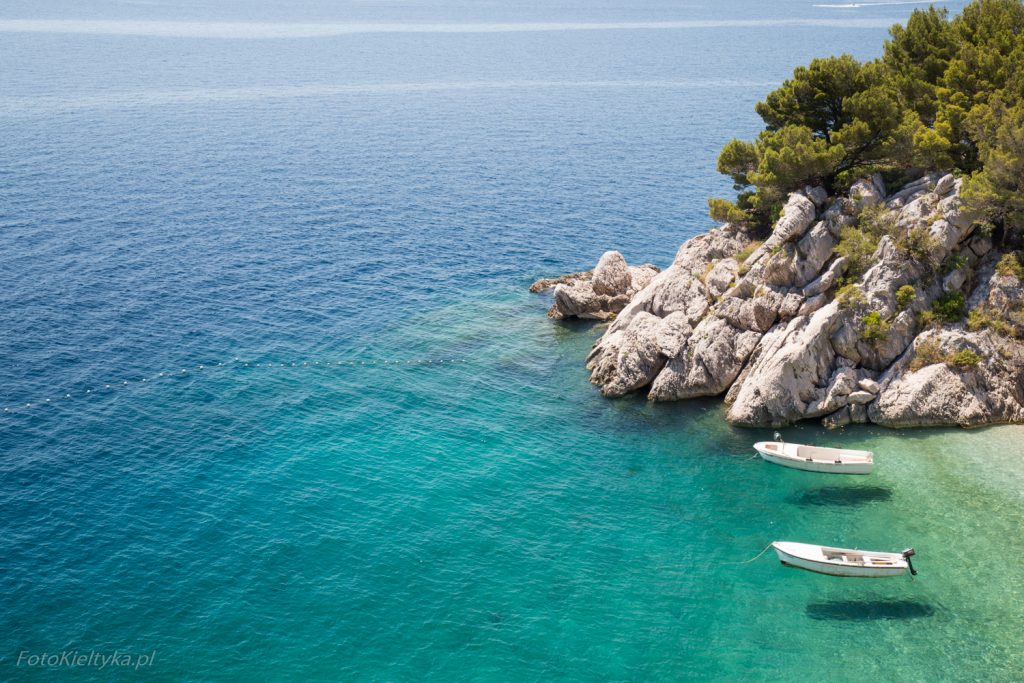
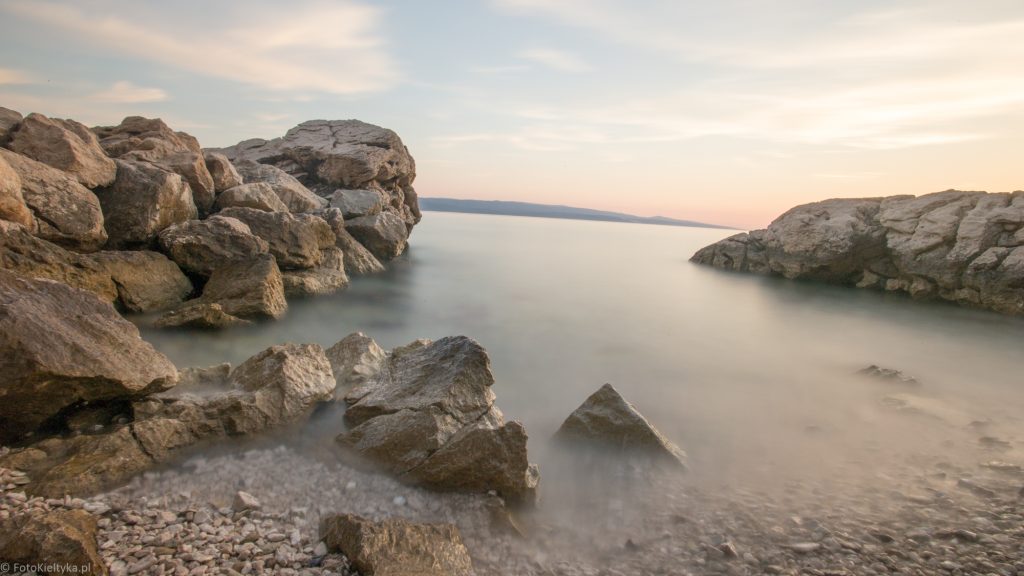
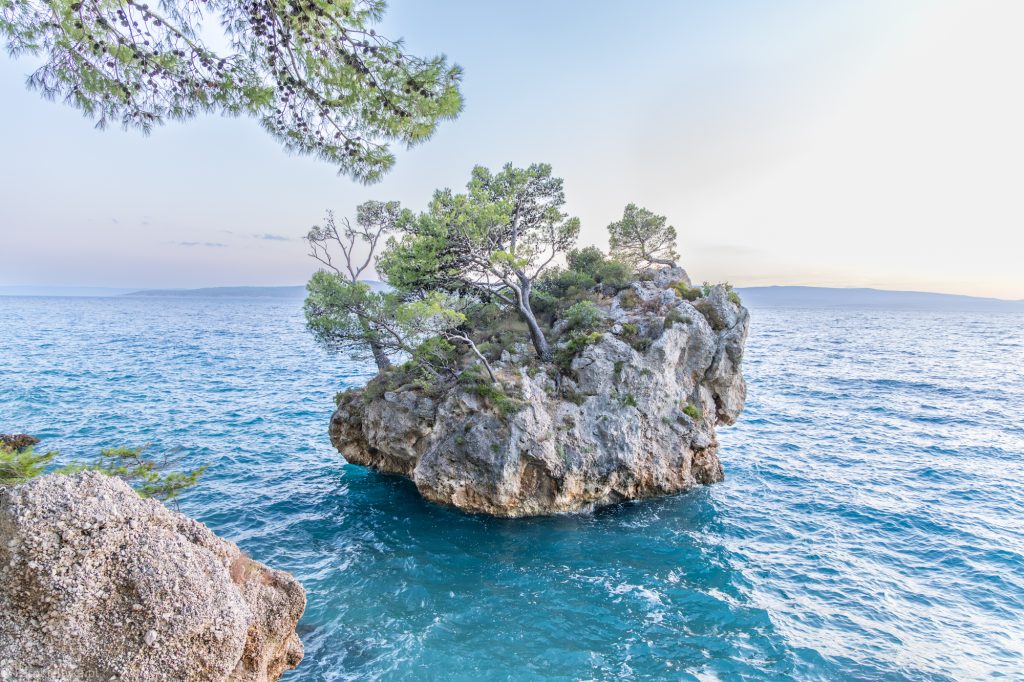
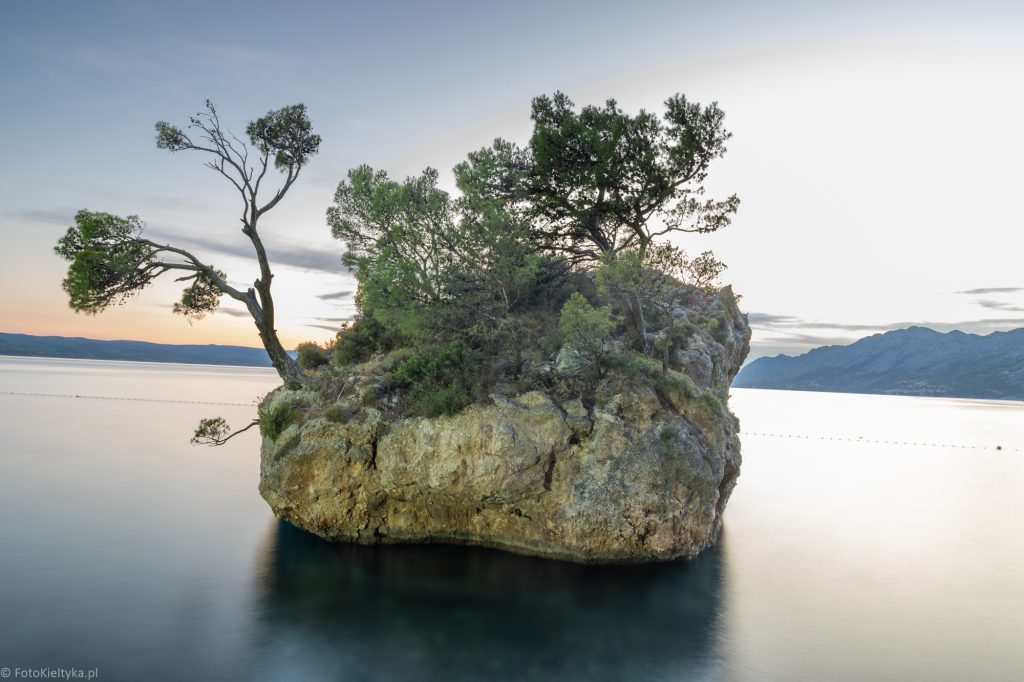
Two views of the coast in Brela — compare the texture of the water and the way movement is depicted.

Photographing clear water — Brela in Croatia

The Croatian Adriatic coast is particularly interesting for the clarity and colour of its water, and for the contrast between pale stones, green vegetation and the blue sea.

Around Brela, these elements can be used to build compositions based on colour and the texture of the landscape.

A very long exposure is not always the best choice for this kind of scene.

If the priority is clear water, visible stones beneath the surface and the natural texture of small waves, a shorter exposure will often work better. Clarity itself also depends on reflections, the viewing angle and conditions in the water.

A good starting point is:

  • ISO 100,
  • f/8,
  • a shutter speed of around 1/125 to 1/500 s, adjusted to the brightness of the scene,
  • a focal length chosen to suit the composition.

These settings can preserve the definition of the water and detail in the landscape, provided the light allows a correct exposure.

Brela — clear water, a stony seabed and the turquoise shades of the Adriatic.

Two small boats on clear turquoise water beside a rocky headland covered with pine trees.

Photographing waves on the Polish coast

The Baltic offers a completely different kind of photography.

On the Polish coast, the most interesting element is often not the colour of the water itself, but wave movement, sea foam, the shoreline and the changing sky.

Fast shutter speeds can freeze the moment a wave hits the shore, water splashes or rapidly moving foam.

With longer exposures, these same elements begin to blur, creating soft lines and a calmer image.

Photographing the moment when water retreats after a wave can be particularly interesting.

At around 1/4–1 second, retreating foam can leave delicate streaks that lead the viewer’s eye towards the sea.

It is best to make several attempts, because every wave moves slightly differently.

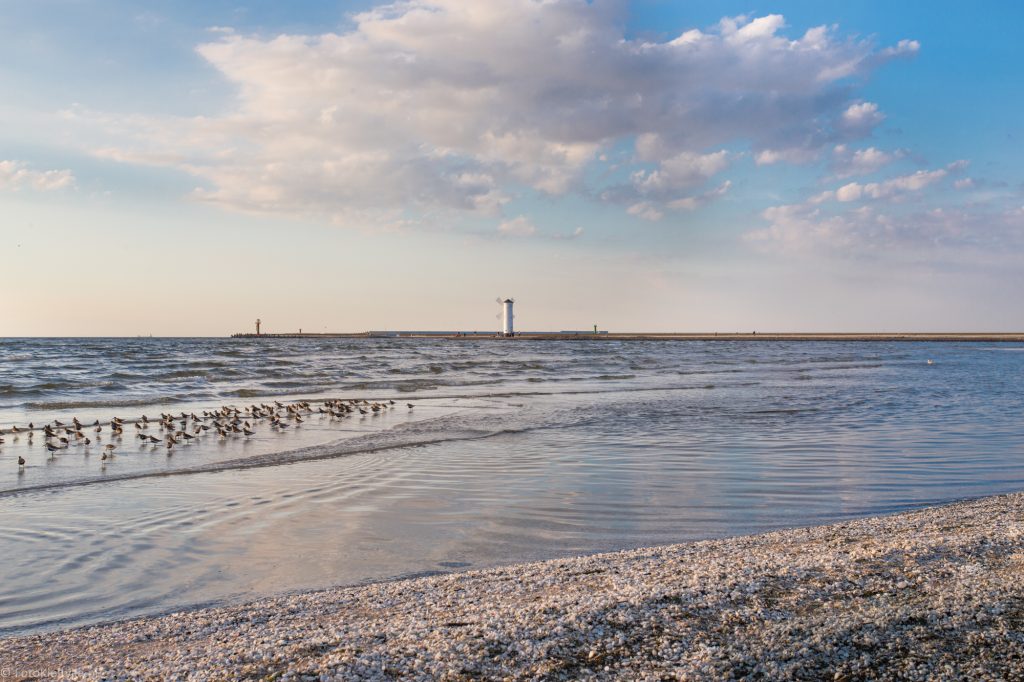
Gąski and Świnoujście — different faces of the Polish coast and moving water.

How can you create a calm, almost motionless sea?

A smooth water surface is one of the most recognisable effects in landscape photography.

Achieving it requires an exposure lasting several seconds.

Depending on wave movement, even a few seconds can noticeably change the appearance of the sea. At 15–30 seconds, the water often becomes very smooth and the details of individual waves begin to disappear.

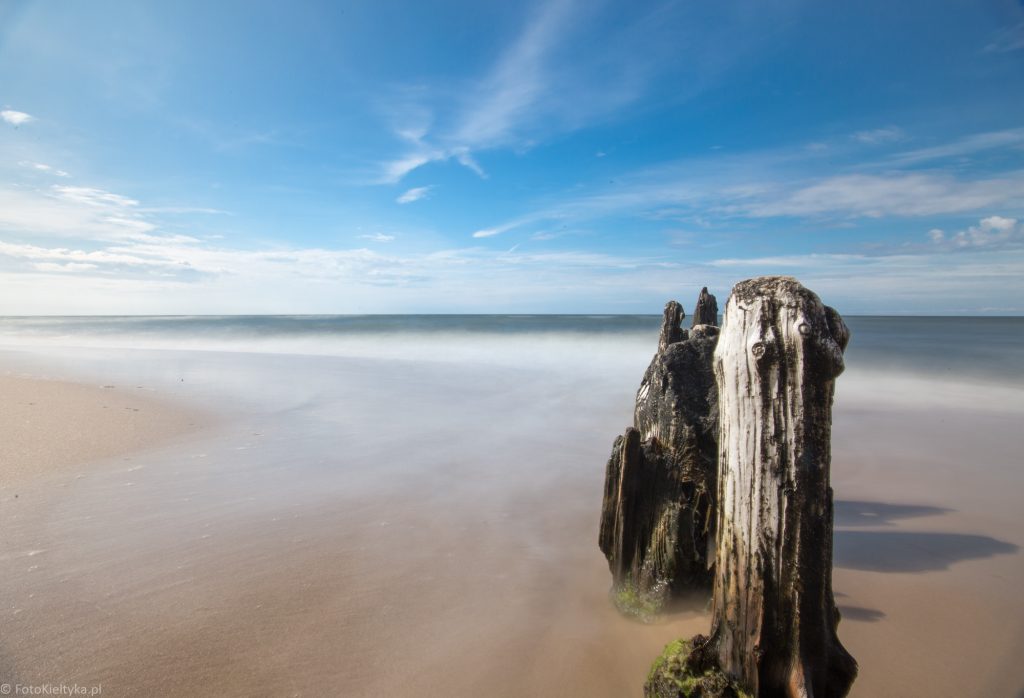
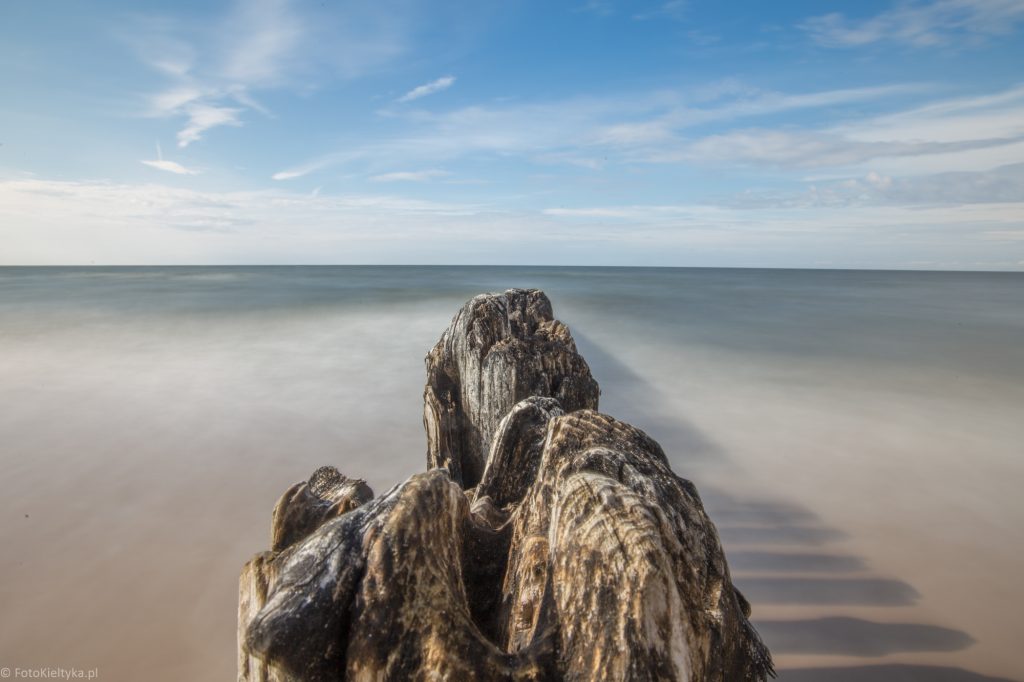
This effect works particularly well in minimalist compositions, for example with a single rock, a breakwater or part of the shore.

When shooting in daylight, a neutral density filter is very useful because it reduces the amount of light reaching the sensor.

It lets you extend the exposure without stopping the lens down excessively. Start at f/8–f/11, a low ISO and a stable tripod. Focus before fitting a strong ND filter, check focus at magnified view and release the shutter with a remote control or self-timer. Set stabilisation on a tripod according to the camera and lens instructions.

ND and polarising filters — when should you use them?

The two filters serve different purposes in seascape photography.

An ND filter allows a longer exposure. It is particularly useful when you want to blur wave movement on a bright day.

For example, an ND64 filter reduces light by six stops. If the correct exposure without the filter is 1/60 s, fitting an ND64 allows a shutter speed of about one second while maintaining the same image brightness at unchanged ISO and aperture. The exact multiplier is 64: 1/60 s × 64 ≈ 1.07 s.

A circular polarising filter, or CPL, helps reduce some reflections from the water’s surface. In favourable conditions, it makes submerged stones easier to see and increases the definition of certain colours.

The strength of the CPL effect depends on the viewing angle and the rotation of the filter. It also reduces the amount of light, so check the exposure again after fitting it.

However, removing reflections is not always desirable. Sometimes sunlight reflecting on the water is the most interesting part of the photograph.

Remember that polarisation can produce an uneven effect across the sky at very wide focal lengths.

Weathered wooden posts in the foreground on the beach in Gąski and the smooth surface of the Baltic Sea.

Water colours and white balance

The colour of the sea is not determined by the sky alone. Water depth and clarity, the seabed, reflections and the direction of light also matter. Not every beach will look turquoise, and there is no need to force that colour during editing.

Shoot RAW. When comparing images, use a fixed white balance so the camera does not change the colours between frames. Check the histogram and bright areas of foam: fully clipped detail cannot be recovered. Adjust saturation to preserve natural differences between water, sky and shore.

Composition — the sea needs a foreground

When photographing the sea, it is easy to concentrate entirely on the horizon.

Yet an interesting photograph often emerges only when a foreground is introduced into the composition.

This could be stones, part of a beach, rocks, waves breaking on the shore, a wooden pier or distinctive plants.

With a wide-angle lens, the foreground is particularly important. It adds depth and guides the eye towards more distant parts of the landscape.

Pay attention to the horizon as well. In most seascapes it should be level, unless you are deliberately using an unconventional composition.

Which lenses work well for seascapes?

A wide-angle lens such as the Canon RF 14–35mm F4 lets you show an expansive landscape, the shoreline and an interesting foreground.

The RF 24–105mm F4 offers considerable compositional flexibility. It can capture both wider views and selected sections of the coast.

A 70–200mm F2.8, meanwhile, can isolate distant waves, ships or sections of shoreline. The narrower angle of view makes compact compositions easier. Perspective and the apparent distances between different planes, however, depend on the shooting position rather than focal length alone.

The widest lens available is therefore not always the best choice.

Light — when should you photograph the sea?

Full sunlight makes it easy to show the colour and clarity of water, especially along the pale, rocky Adriatic coast.

During golden hour, the light becomes warmer and waves and stones can cast long shadows.

After sunset, continue shooting during blue hour. The cool colours of the sky and water work well with exposures lasting several seconds.

Do not give up on overcast days either. Diffused light makes contrast easier to control and can be especially helpful for long-exposure photographs.

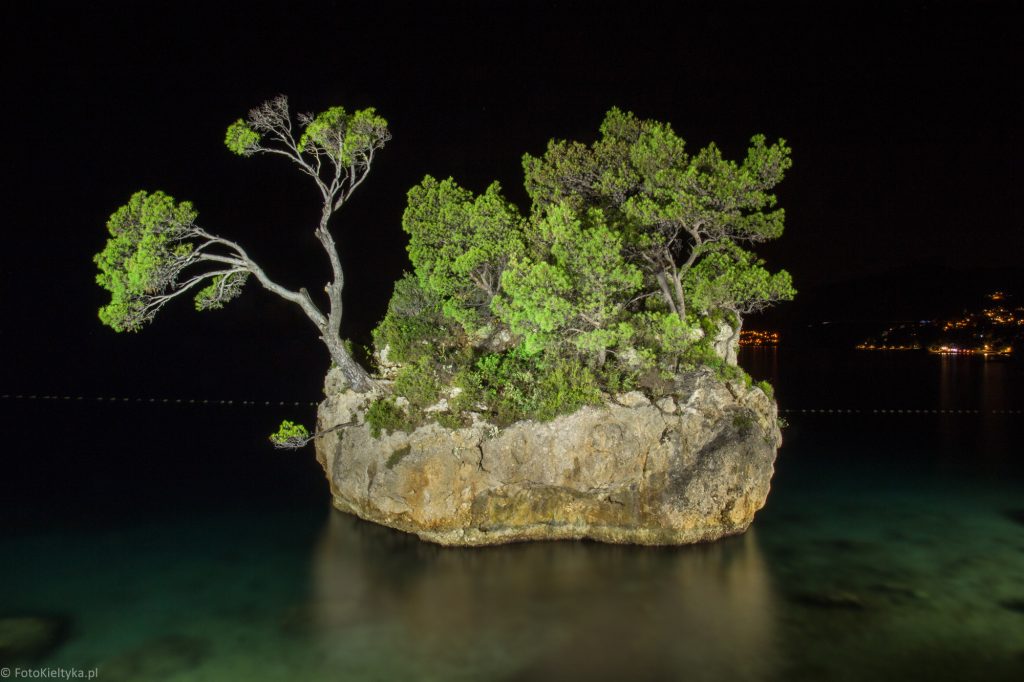
Illuminated pine trees on a rocky islet in Brela against the night sky and sea.

Safety and protecting your equipment

When photographing the sea, keep sand, salt water and unpredictable waves in mind.

Do not position your tripod too close to the surf, particularly in strong waves. Even an apparently calm sea can suddenly soak your equipment.

Salt water is particularly harmful to electronics and metal camera components. Avoid changing lenses in strong wind and protect your equipment from spray and sand.

No photograph is worth the risk of stepping onto slippery rocks or into an area exposed to large waves.

Choose the effect you want to show

Photographing the sea offers enormous scope for experimenting with shutter speed.

A short exposure freezes wave movement, a longer one emphasises its motion, and an exposure lasting several seconds can turn a restless sea into an almost perfectly smooth surface.

Brela and the Polish Baltic coast show how different photographs of the same element can be.

There is no single best shutter speed for water. What matters most is the effect you want to achieve and the story you want the photograph to tell.

Read also